

In the Future of Voice AI series of interviews, I ask three questions to my guests:

- What problems do you currently see in Enterprise Voice AI?
- How does your company solve these problems?
- What solutions do you envision in the next 5 years?
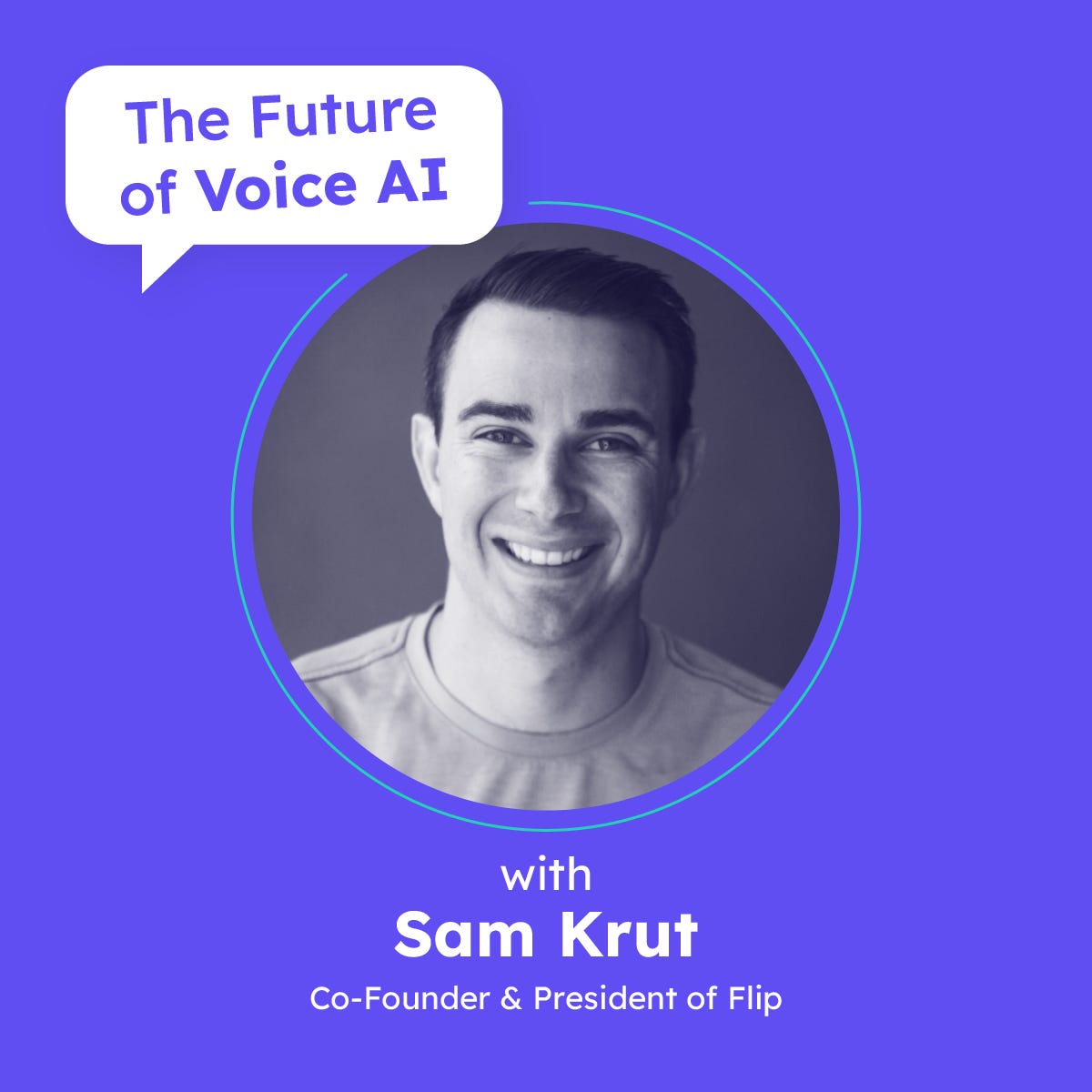
This episode’s guest is Sam Krut, Co-Founder and President of Flip.
Sam Krut is co-founder and President of Flip, the conversational AI platform helping leading brands transform how they serve customers over the phone. Since co-founding Flip, Sam has worked closely with clients across retail, healthcare, and transportation to deploy AI across some of their highest-volume and most complex customer and patient interactions. He brings a firsthand perspective on how conversational AI is evolving beyond call deflection and cost savings to resolve customer needs, drive business outcomes, and reshape the role of the contact center.
Flip is the conversational Voice AI platform purpose built for retail, healthcare, and transportation. Flip's leading phone AI autonomously resolves customer service calls end-to-end, replacing outdated IVR systems with fast, natural, and brand-consistent experiences at scale. With 300+ million calls processed, 250+ enterprise clients, and 80+ native integrations, Flip is the trusted Voice AI partner for brands including Under Armour, TrustCare, and Curb Mobility. Founded in 2018, Flip is headquartered in New York, NY and has offices in LA and the UK.
Recap Video
Takeaways
Vertical depth is becoming a real moat in voice AI because repeatable workflows and integrations matter more than a generic agent that can talk about anything.
Voice AI’s biggest competitive advantage may shift from model quality to system access, because an agent that can’t act is still just a better IVR.
70–90% automation changes the contact center from a human operation supported by AI into an AI operation with humans handling the exceptions.
The real enterprise AI problem is not knowledge retrieval; it is turning undocumented human judgment, exceptions, and workarounds into something machines can reliably execute.
Better models alone will not unlock higher automation if the underlying business still runs on weak APIs, fragmented systems, and manual processes.
The market may be overbuilding general-purpose voice agents when the strongest economics come from solving the same narrow workflows repeatedly across an industry.
“Containment” can hide failure because keeping someone away from a human does not matter if the customer has to call back.
Outcome-based pricing could become a forcing function for the industry, because vendors only make more money when the customer actually gets more value.
The push for one giant model may reverse as smaller models get capable enough to handle speed-critical tasks while larger models handle context and reasoning.
Speech-to-speech is still easier to demo than deploy because natural conversation means little if the system loses context or cannot reliably use tools.
Voice AI may be closer to technical readiness than organizational readiness, with enterprises now setting the ceiling on automation more than the technology does.
If AI agents need the same tools, permissions, and process updates as employees, companies will eventually have to manage them more like digital workers than software features.
The rise and fall of dedicated “AI” roles would be a sign of success, not failure, because mature AI disappears into the teams and workflows that already own the business outcome.
BPOs face a business-model shift more than an extinction event, as value moves away from supplying labor and toward process expertise, exception handling, and AI-enabled operations.
As conversation quality improves, voice AI differentiation will move down the stack into latency, orchestration, integrations, and workflow execution.
The industry’s biggest adoption problem may soon be reputation debt: years of bad automated phone experiences have trained customers to expect failure before the conversation even starts.


